A "Good" Developer: Impostor Syndrome & The 10X Engineer
There is a specific pattern of thought in software engineering—and also most industries—that seems to trickle into developers' minds: the Impostor Syndrome.
Context
The premise behind the Impostor Syndrome—for anyone who hasn't yet looked it up after experiencing it—plays into a similar concept as the Dunning-Kruger effect. Without knowing a whole lot about the details of this, at least in the psychological sense, the effect describes a cognitive bias where ones internally perceived ability does not match their "actual" representative ability on some topic, skill, etc.
What this leads to in terms of behavior, is what is informally known as 'Mount Stupid", a state of overconfidence. In the early stages, as experience grows, confidence can nosedive as the realization regarding how much more there is to know kicks in. After this, confidence slowly increases as actual experience increases.
A Totally Scientifically Accurate Curve
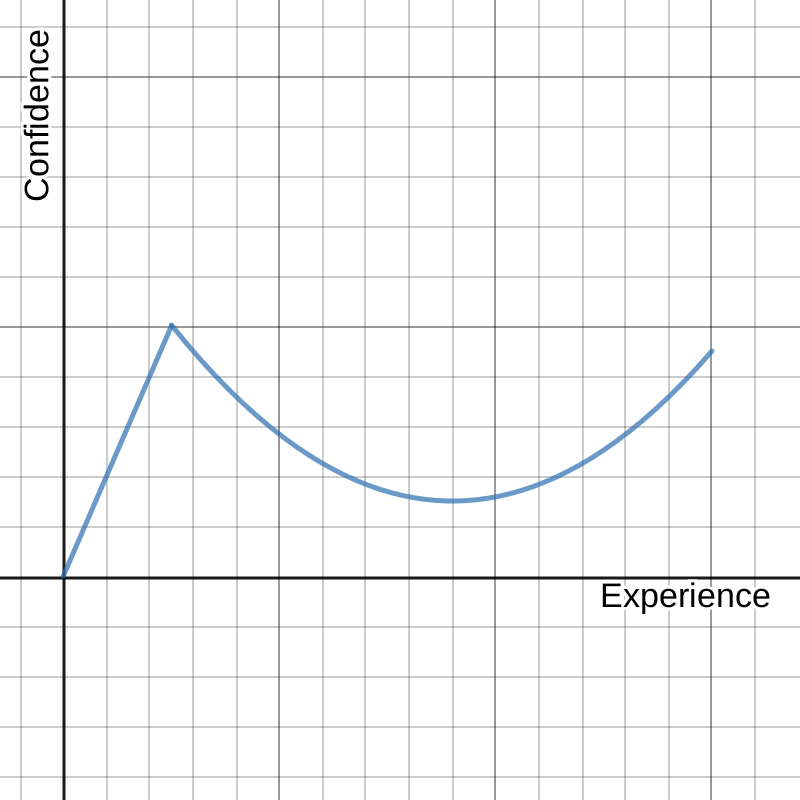
The reasoning behind the whole effect lies on the fact that people don't know what they don't know, and knowing a little bit can be easily and imperceptibly mistaken for knowing a larger chunk relative to the "total" amount to know.
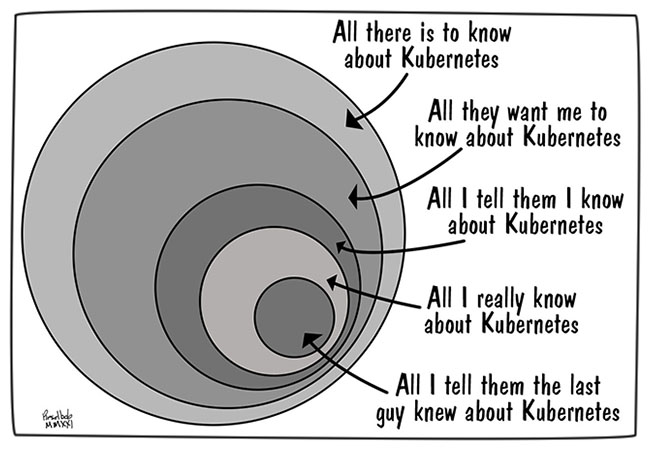
From Industry To Personality
A key problem this puts forth in the real world is a surge in potentially under-qualified and overconfident individuals, making it harder to screen qualified developers. For example, a more (falsely) confident developer could appear as a better candidate for an initial screening for a variety of reasons including: spoken/body language confidence during an interview, having a lot of "trendy" knowledge in a certain field, and more.
This issue goes much further than job hunting and careers though. From personal experience, being oblivious about your strengths and weaknesses reenforces nasty habits such as messy code or code style, using problematic or outdated packages/libraries/techniques, and the more serious problem of misleading interaction with other developers.
Everyone's An Influencer
The rise of online content creation, specifically in the form of blogs, social media influencers (tech twitter, etc), has also led to a sort of weird phenomenon where anyone can write content and have that content consumed by anywhere between 0 to literally millions of people. Don't get me wrong, this is one of the great powers of the internet, and is also exactly what this post you're viewing also falls under. The tricky thing with the 'anyone is an influencer' thing is that the spread, or virality if you will, of content on the internet sometimes has a disconnect between an authors credentials on the subject and what they're actually writing. Say for example, person A writes an article on how technology X is incredible, or how technology Y is absolute garbage. The article can simply be posted and linked to by anyone on a blog or Twitter and regardless if all the information is 100% correct, some people will always either internalize that information, or use it as evidence in some later argument on the web.
Here is an additional reading list with some studies and articles targeting the spread of information on the internet:
https://mitsloan.mit.edu/ideas-made-to-matter/study-false-news-spreads-faster-truth
https://www.pnas.org/content/113/3/554
Getting back to the land of software, the prime example of this type of content can be often found in places like dev.to, or Medium. While there's lots of good stuff on those sites, there's also a ton of bad content ranging from inexperienced or 'noob' code, ugly/spaghetti code, indirectly promoting bad practices or advice, to flat-out wrong articles. There's also the slightly different
Counterargument
Before the Medium tech bloggers storm in with the pitchforks, I'd like to also mention that platforms that allow this type of information sharing are still critical to building content ecosystems, allowing civilized discussion, and most importantly the ability for anyone to read and learn an insane amount of stuff. The points mentioned before also of course apply to places like Stack Overflow, which has its own mess of contributions if you go looking, but that's besides the point.